By Sarah Gorham Silverman of Baby Moon Tri-Fit
While many people may not be able to tell on the outside that a person is pregnant in their first trimester, it is often the most challenging trimester of pregnancy, the primary reason often being nausea. And, let’s please not call it “morning sickness,” because nearly every mama that I’ve met going through this is experiencing it throughout the entire day.
Before I get going about this topic and how a yoga practice may best support a person struggling with pregnancy nausea, I’d like to offer a support tip or two. As well intentioned as it may be, if you’re reading this and you have not ever experienced pregnancy nausea, I urge you to NOT ask the miserable nauseous person if they’ve tried ginger. We’ve heard of that technique to help nausea, and it does very little. It’s still worth a try and may take the edge off of nausea, but its effects don’t last long for most of us. A wonderful way to support a pregnant person experiencing nausea is to pause and hear them, and if it’s appropriate, maybe give them a nice hug. We just need to be heard and feel like we can be in a space where it’s ok to say that pregnancy sometimes really sucks.
How every person encounters pregnancy and the common symptom of nausea will be unique , but there is often some common ground, so I’ll share a bit about my pregnancies. During my past pregnancies, I began feeling the first hints of nausea about five days before my first missed period. From that day on, it slowly got worse until it peaked (when it’s at its worst), which in pregnancy number 1 was around 12 weeks, and in pregnancy number 3 around 15 weeks. I had another pregnancy in between those, which resulted in a miscarriage, and even though the embryo was not properly developing and passed around 6 weeks, I still felt nauseous until the pregnancy had to be terminated at 11 weeks. The nausea in my first pregnancy felt gross but rarely resulted in vomit. I just felt pretty shitty all day, and it got the most unpleasant at night. Eating definitely helped, and an empty stomach exacerbated symptoms, so I had to have crackers or a banana with me at all times. Nausea in my third pregnancy began as early as in the first one (before first missed period = 3 weeks pregnant), and it got to be quite miserable by six weeks pregnant. I could rarely hold down food; exercise was dreadful, and I felt it 24/7. What got me through this time was Einstein’s Bagels and an iPad that my 2 year old and I watched together while lying on the couch. It was during the pandemic, so there was little support around us. Despite my wishful thinking that it would peak at 12 weeks, like the internet said on website after website, it finally began decreasing around 18 weeks of pregnancy and was mostly gone by 23 weeks. Up until this time, I had been pretty depressed and upset most days and was not enjoying pregnancy whatsoever. I was taking Unisom, which helped lessen my symptoms and kept me from vomiting as much. This was a very challenging time, and I know people who’ve had much worse nausea and vomiting, some of which have to be hospitalized for fluid IV replacement, also known as hyperemesis gravidarum.
Here are some facts about nausea in pregnancy.
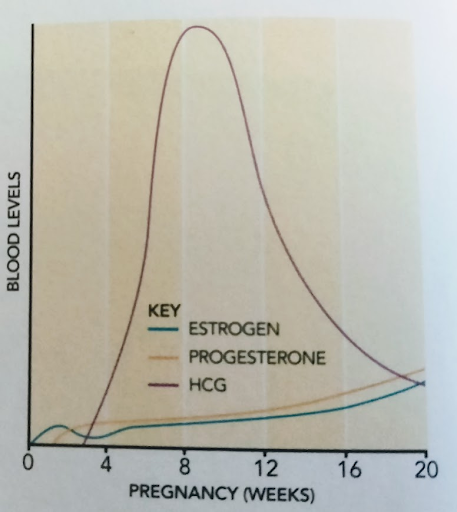
Nausea during pregnancy may be mild to severe lasting for short segments of the day or all day with or without vomiting. Eating regularly often decreases its intensity. Pregnancy nausea and vomiting decreases for many around weeks 12-14, and for many others may continue for another month or two, or for some their entire pregnancy. This improvement could be due to the 30% drop in hCG (human chorionic gonadotropin) levels. It is unknown what exactly causes nausea and sickness, but it has been linked with low blood sugar, increased secretion of bile, and raised levels of the hormones hCG and estrogen.
See the chart below illustrating the changing levels of Estrogen, Progesterone, and HCG in early pregnancy.
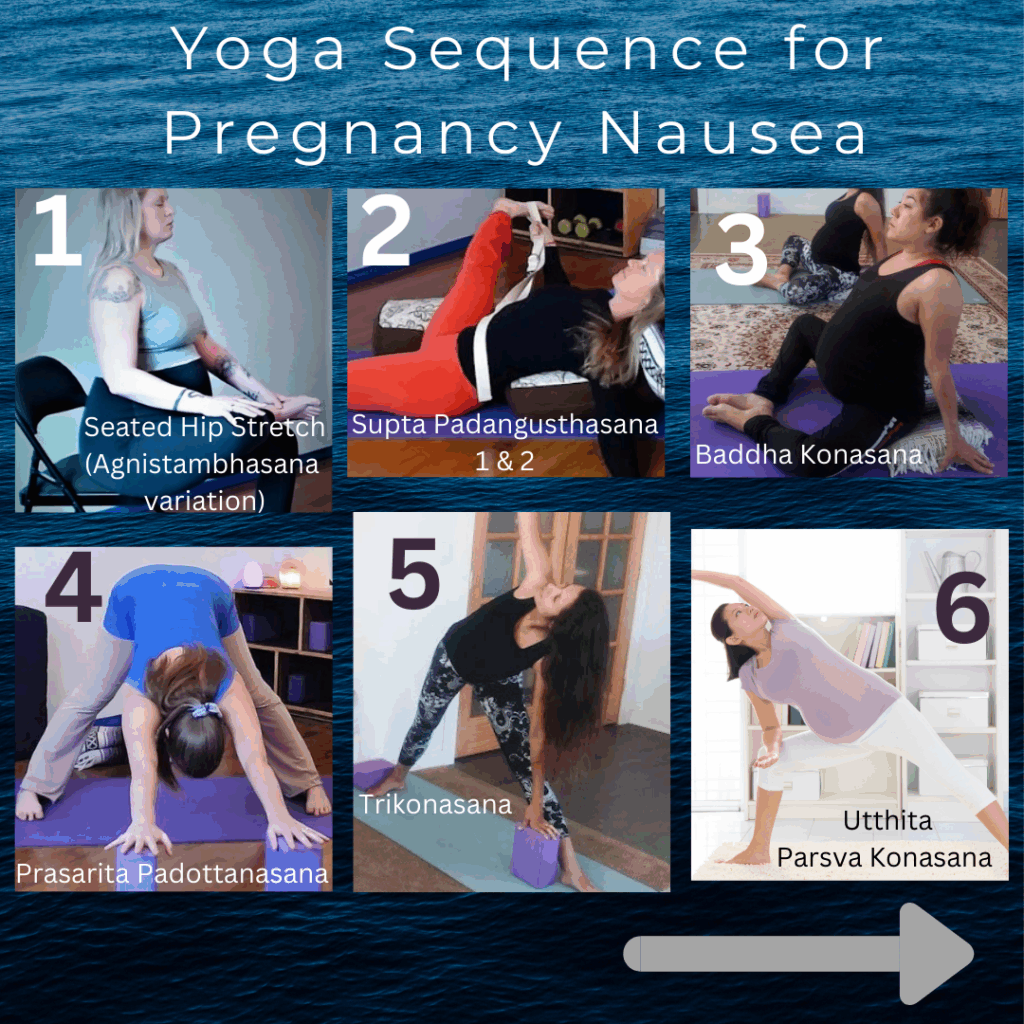
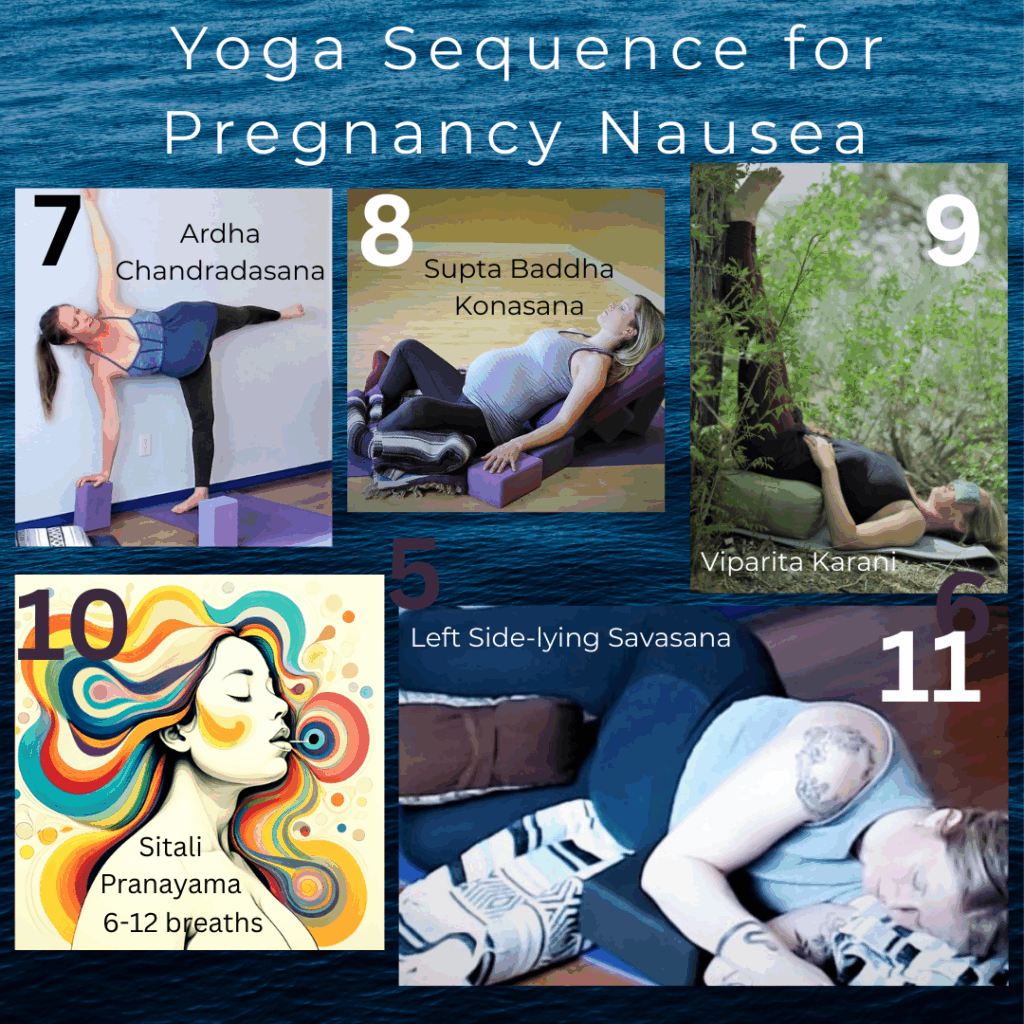
A New Yoga Practice for Pregnancy (all images of postures listed in this article are at the end)
Practicing yoga during pregnancy can be wonderful and may help manage symptoms of pregnancy nausea, but it’s important to be practicing in a way that does not exacerbate symptoms.
Here are some things to consider when exploring Prenatal Yoga to help manage or cope with pregnancy nausea:
- How you feel going up & down: Notice how you feel after going up-and-down frequently, as you may do during a Sun Salutation (Surya Namaskar) or when coming in and out of Downward Facing Dog Pose (Adho Mukha Svanasana). This up-down movement may not be an issue for some, while in others it may increase nausea and lead to vomiting. A nice alternative to Downward Facing Dog Pose is L-Pose using the wall. For some in the first trimester, the increases in progesterone are already softening the esophageal sphincter and causing some acid reflux, which can also be exacerbated by going upside down when this symptom is active and may increase one’s risk of vomiting.
- The Intensity of a Yoga Practice: Invite yourself to slow down if you’re used to vigorous types of yoga. You can go back to your vigorous practices after pregnancy, and you may find that there can still be a nice level of intensity in a slower practice. For those facing pregnancy nausea, vigorous movement may make them feel worse and depleted. Think quality over quantity. Invite yourself to take out some Sun Salutations and/or “vinyasas”. Your practice does not need to “flow” to connect postures. Instead try a handful of standing postures like Tadasana (Mountain Pose), L-pose with the wall, Trikonasana (Triangle Pose), Utthita Parsva Konasana (Extended Side Angle Pose), and Ardha Chandradana (Half Moon Pose – I recommend with your back to a wall). Long-time and expert prenatal yoga teachers, Linda Spackman and Linda Sparrowe, recommend Ardha Chandrasana for relieving nausea. Hold the postures while slowly breathing for 2-5 breaths, depending on the intensity level for which you’re looking.
- Consider a Practice off of your feet: If your nausea is severe, you may need to do a mostly seated or supine practice and stay off of your feet. Maybe you do one or two standing postures like Trikonasana (Triangle Pose) and Ardha Chandradasana (Half Moon Pose) at the wall, and the rest of your practice is on the floor. The Supta Padangusthasana (1-3) series is fantastic for the 1st trimester and nausea, and it is also the perfect way to prepare for Trikonasana and Ardha Chandradasana. Keep in mind that deep twisting is NOT recommended throughout pregnancy and especially not in the first trimester, so keep Supta Padangusthasana 3 mild and mostly focused on releasing the outer hips. Moving through asanas (postures) on your back can be quite transformative for the body-mind. They allow energy to shift in your body, increase circulation through the body (including the uterus), and they serve as a method of slowing down and being in the present, which results in a feeling of calm.
- Consider doing more Restorative Postures: For severe nausea, your entire yoga practice may need to be fully composed of restorative postures. These are long-held (5-15 minutes depending on the posture) postures that are supported by props, like bolsters, blankets, and props to aid in gentle openings and deep restoration. Supta Baddha Konasana (Supine Bound Angle Pose) and Viparita Karani (Legs up the Wall) are great examples of restorative postures for pregnancy.
- Consider Pranayama: Breathing exercises (pranayama) are highly recommended in pregnancy so that the pregnant yogi receives the shift of awareness and energy that often occurs as a result of mindfully breathing. Pranayama leaves one feeling calm and in a state of greater ease and presence. It often cools down nausea and helps the pregnant person rest more deeply and fully, so these are great to do just before the final rest of your yoga practice and right before bedtime. Try gentle pranayama exercises like:
- Sitali – inhaling slowly through the roll of your tongue and exhaling slowly with the mouth closed. 6-10 rounds.
- Nadi Shodhana – inhaling slowly through the left nostril, exhaling slowly through the right nostril, inhaling slowly through the right nostril, and ending the round by slowly exhaling through the left nostril. Repeat the full round 3-4 times.
- 3-part breathing – inhaling slowly into the belly and low back, then into the ribs, and lastly into the front and back of the chest. Exhale slowly and fully. Repeat 6-12 times.
- Bhramari Pranayama (Bee’s breath) – Close the eyes and gently plug the ears. Inhale through the nose slowly, and exhale slowly while humming. Repeat 5-7 times.
Supine and seated postures, restorative postures, and pranayama may be the focus of one’s practice during this time. Some may feel a decrease in nausea through movement and gently using their muscles, while some may require more restorative types of postures with little movement.
Try a few different types of prenatal yoga practices and give yourself the space to examine which types feel the most supportive to your body-mind and the process of nurturing a developing embryo and fetus.
Try out the sequence below and tweak it according to your needs.
- Seated Hip Stretch (Agnistambhasana variation): 1-2 minutes each side.
- Supta Padangusthasana 1 (with heel reaching towards ceiling) & 2 (as shown in image below) w/ an inclined bolster after 14 weeks pregnant, can flat on back prior to 14 weeks: 1 minute for 1 & 2 on each side.
- Baddha Konasana w/ 1-2 blankets under seat: 6 breaths.
- Prasarita Padottanasana: 4-5 breaths.
- Trikonasana: 2-5 breaths.
- Utthita Parsva Konasana: 2-5 breaths.
- Ardha Chandhrasana: 2-5 breaths
- Supta Baddha Konasana, incline after 14 weeks pregnant: 5-10 minutes.
- Viparita Karani w/ low back on bolster, if undergoing fertility treatments this can help improve fertility, but check with your provider before you try this to make sure they approve: 3-10 minutes.
- Sitali Pranayama: 6-12 breaths
- Left Side-lying Savasana: 5-10 minutes.