Pregnancy comes with a range of emotions and physical symptoms that can vary greatly depending on the person. Many of these feelings and symptoms are triggered by the buffet of hormones that flood a pregnant person’s body, one of them being the reproductive hormone Relaxin, .
I remember as a pregnant yogi that physical sensation that hit me a few weeks into pregnancy that made my body just want to, as the word implies, relax. I had been used to practicing yoga everyday in a way that encouraged the use of muscle energy, or emphasized strong and well-aligned postures, but very soon into my first pregnancy, it was much more challenging to bring strength into the asanas (postures). My body felt like it wanted to disengage from the stronger types of asanas and simply lie down, rest, and stretch. While following that desire to rest and stretch more is useful and encouraged, I also think it’s important to continue a modified version of a yoga practice that includes at least a few of the stronger standing postures so that the pregnant body can maintain some of its strength and stability and overall health and wellness throughout a pregnancy.
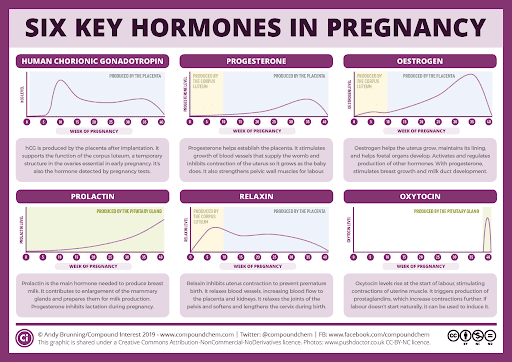
Relaxin is produced by the ovaries and the placenta after ovulation and during pregnancy. Its levels are elevated throughout an entire pregnancy but peak around 14 weeks. Relaxin plays an important role in the 1st trimester of helping to prepare the lining of the uterus for implantation, grow the placenta if implantation occurs, and preventing early contractions and miscarriage by relaxing the uterine muscles. Relaxin also softens the muscles, joints and ligaments during pregnancy to help one’s body accommodate the growth of the uterus and baby, and it helps one’s body prepare for childbirth by loosening the muscles and ligaments in the pelvis. Because of relaxin’s loosening effects on the muscles & ligaments, one may have a greater risk of injury from the overall decreased instability that it produces in the body. This is why it is necessary to continue doing safe and pregnancy-appropriate exercises to keep one as stable, strong, and well-aligned in their body as possible. This is also why, as a prenatal yoga instructor, I emphasize elements of strength, alignment, and the use of props for safer and more supported postures.
Below are 5 tips to consider when practicing prenatal yoga to support the effects of Relaxin on a pregnant body:
- Prop up Your Seat – I say often while teaching yoga that posture matters for every body but that for pregnancy it is a crucial matter. It is important that a pregnant person be able to find a neutral pelvic position when sitting (and standing too!). What this means is that their knees are slightly angled down from their hips (helps maintain a lengthened psoas muscles and tip the pelvis towards neutral) and their weight is mostly off of the tailbone or coccyx and just barely forward of the sitting bones or ischial tuberosities. While sitting, one’s low back lumbar curve should be slightly curved in, or slightly lordotic, which sets up the rest of the spine to be nicely aligned and presenting its neutral curvature. What does this have to do with relaxin? I see so many pregnant mamas who share with me that they’re feeling discomfort and achiness in their lower backs with often a feeling of surprise, because they’re only in the first trimester when not a huge amount of growth has occurred yet. Those in the first trimester of pregnancy especially need the necessary prop support to encourage optimal alignment while sitting due to relaxin’s high levels, which are peaking near the end of the first trimester. These high levels of relaxin create a scenario of decreased stability and greater mobility in the pelvis and spine that can lead to collapse and misalignment of the joints and ligaments if not appropriately supported. This may look like a person sitting with their weight dumping into their coccyx, which will present a rounding or deletion of the natural/neutral curvature in the lower back, and ultimately may lead to pain and discomfort.
- Support Deep Stretches – I recommend that in most people long-held, unsupported deep stretches like that in Yin Yoga be avoided during pregnancy. This can place undue strain on the already loosened ligaments to possibly stretch beyond what is safe in that moment, potentially leading to greater degrees of instability in the body. Don’t get me wrong, stretching in pregnancy is important for establishing greater balance in the body and for helping the body prepare for labor but only within the body’s healthy stretching zones and with a focus of stretching the muscles versus the joints. While stretching in pregnancy, I highly recommend using props to help support stretches and to discourage reaching the zone of deepest stretch. I usually say something like, “enjoy this stretch to a place that feels like you’re reaching about 80-85% of your body’s maximum stretch potential.” If a stretch is being held for over a few breaths, I recommend that a prop be positioned in a way to help hold the stretch and discourage the body from collapsing into deep stretch that could place undue harm on the joints and ligaments. Here are some examples of using props in stretches:
- Supta Padangusthasana 2 with a blanket or bolster underneath the outer thigh
- Upavista Konasana with a blanket or two under the sitting bones (enough to establish a neutral pelvis) and a chair under the forehead
- Supta Baddha Konasana with some support underneath each thigh
- Include Pregnancy-Safe Toning Exercises – A pregnant person may benefit from including toning exercises in their practice like outer hip strengthening clam shells and other similar types of hip movements. I recommend trying these first with a certified prenatal yoga instructor or physical therapist who will know how to help you set up properly for these exercises so that you are targeting the desired muscles. I like to focus on the following muscles groups for pelvic stability:
- Outer hips (abductors) – exercises include clam shells, fire hydrants from a table position, and side-lying leg circles
- Inner thighs (adductors) – exercises include squeezing a block between the fronts of the inner thighs while standing in Tadasana (Mountain Pose) to encourage more internal thigh rotation (make sure that the butt is not clenching), squeezing a block between the knees while sitting on a chair (with great posture!), and wall sits while squeezing a block between the fronts of the inner thighs (see video below).
- Gluteal muscles in the buttocks – exercises include donkey kicks while keeping the hips as squared as possible and emphasizing lifting through the inner thighs and performing yoga postures with a strong attention placed in the heels, especially when doing chair postures or squats.
- Pelvic floor muscles – I encourage seeing a Pelvic Floor Physical Therapist to help you properly perform pelvic floor exercises, including knowing how to soften and fully relax the muscles. A prenatal yoga class may include simple exercise like inhaling while you soften and relax the pelvic floor muscles and gently engaging and lifting the pelvic floor muscles while exhaling for 5-10 breaths in a well-aligned seated posture or child’s pose (Balasana).
- Abdominal muscles – exercises include gentle belly breathing which entails inhaling while you soften the abdomen and gently hug your baby back towards your spine with your muscles as you exhale for 5-10 breaths. Once abdominal belly breathing is feeling well understood, try the Bird Dog abdominal exercise while hugging your baby back towards the spine for 3-5 breaths.
- Use the Wall for Support & Postural Integrity – The wall is a wonderful prop anytime and especially in pregnancy. I will often create entire sequences with the back foot pressing against the wall for standing postures (see video below). Pressing the outer foot against the wall in standing postures like Triangle Pose (Trikonasa), Utthita Parsva Konasana (Extended Side Angle Pose), and Virabhadrasana 2 (Warrior 2 Pose) not only helps the pregnant yogi balance but it also recruits the inner thigh adductor muscles to turn on and support the pelvis as well as the major muscles in the legs, which results in an overall stronger and well-aligned posture.
- Rest, Ground, & Reset – The high relaxin levels in early pregnancy contribute to there being an excess of the Ayurvedic dosha, Vata, which is often considered to be in excess throughout pregnancy, and may be even more so in the 1st trimester. There are 3 doshas, and the Vata dosha is associated with lightness, airiness, anxiety, and a feeling of being unsettled or ungrounded, among many other things. Practicing strong and well-aligned postures in pregnancy can help a yogi feel stable and strong in their bodies, which may translate as a quality of feeling more grounded and settled in the nervous system and body-mind. Another useful practice to help cultivate a sense of grounding is to actually rest deeply. Let the body relax deeply in restorative postures and Savasana variations. Allow the weight of your body to drop into the floor and feel the floor beneath you. Be patient in the process of rest. I encourage you to rest in a restorative posture like Supta Baddha Konasana for at least 10 – 20 minutes. You will most likely “wake up” feeling refreshed, renewed, and grounded.
See the chart of pregnancy hormones from: www.compoundchem.com